


The compressor, as the core component of the refrigeration system, directly impacts system performance, maintenance costs, and service life. This article will provide an in-depth analysis of the advantages and disadvantages of three mainstream compressor types—fully enclosed, semi-enclosed, and open—and focus on their maintenance costs and service life performance.
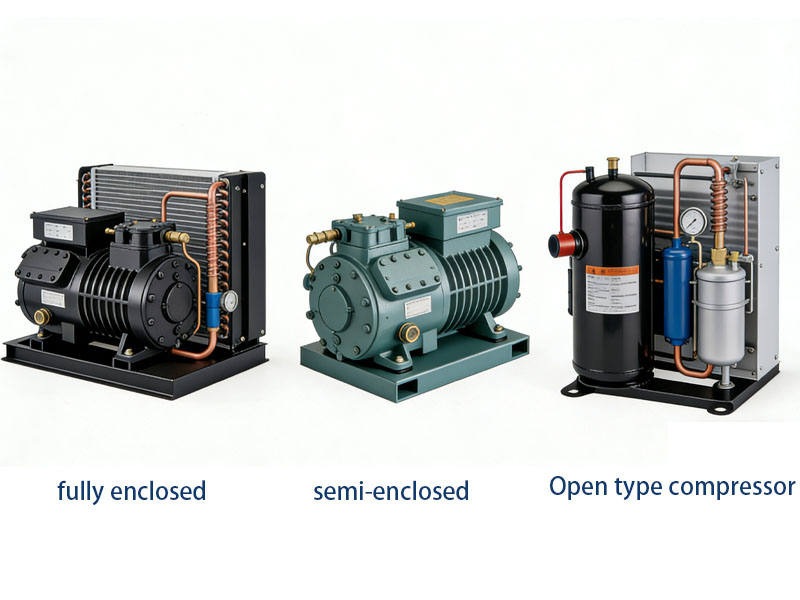
Common applications: household refrigerators, air conditioners, and small commercial refrigeration equipment
Typical capacity range: typically less than 10 horsepower
Common Applications: Medium-sized commercial refrigeration systems, industrial cooling equipment
Typical capacity range: 5-100 horsepower
Common applications: large industrial refrigeration systems, specific commercial settings
Typical capacity range: Generally greater than 20 horsepower
The operating noise is relatively low
Compact in structure, easy to install
No need for shaft sealing, completely eliminating the risk of refrigerant leakage
The manufacturing cost is relatively low
The heat dissipation performance is relatively poor
The power range is limited and not suitable for large-scale systems
The efficiency is generally lower than that of semi-enclosed counterparts at the same level
The heat dissipation performance is superior to that of fully enclosed types
Efficiency is generally higher than that of fully enclosed systems
Wide applicability and diverse capacity options
Partial repairs can be completed on-site
The noise level is higher than that of fully enclosed types
The initial investment cost is relatively high
Regular maintenance is required
The motor can be replaced individually, offering high flexibility
Optimal heat dissipation performance
Suitable for special working conditions and customized requirements
Theoretical service life is the longest (with proper maintenance)
The loudest noise
Belts or couplings are required, increasing maintenance points
High requirements for installation accuracy
Energy efficiency is typically the lowest (due to transmission losses)
Semi-enclosed: Moderate. Requires regular replacement of lubricants, filters, and seals
Open type: Maximum. Frequent inspection of shaft seals, belts, couplings, and alignment is required
Semi-enclosed type: Controllable and predictable. Replaceable wear parts such as valve plates and piston rings, with moderate cost
Open-type: Continuously high. Requires regular overhauls, but the cost per instance remains relatively reasonable after allocation
Semi-enclosed type: May require motor rewinding or comprehensive overhaul, but the cost remains lower than replacing the entire unit
Open type: Stable maintenance costs, with the lifespan extended indefinitely through periodic component replacement
Key finding: Although open compressors have the highest annual maintenance costs, their reparability suggests that the total holding cost may be the lowest over a 15-20 year cycle, particularly for high-power applications.
Semi-hermetic compressor: 12-20 years (designed with maintainability in mind)
Open-type compressor: 15-30 years or more (designed as a long-term maintainable equipment)
Open type: Sensitive to dust and humidity, but can be improved with protection
Semi-enclosed: Moderate maintenance can significantly extend lifespan
Open-type: Achieves ultra-long lifespan under strict maintenance
Semi-enclosed: offers better adaptability to load variations
Open type: Most suitable for variable load and heavy-duty applications
Limited equipment space
Hope for the lowest daily maintenance
Lower power demand (<10HP)
Plan to replace directly rather than repair in case of failure
Medium power demand (10-100HP)
Desired on-site repair capability
A good energy efficiency performance is required
Pursuing the longest service life
Capable of performing regular professional maintenance
Special application requirements (e.g., ammonia refrigerant)
The goal is to minimize the total lifecycle cost
Semi-hermetic compressor: New sealing technology and high-efficiency motor design reduce maintenance requirements
Open-type compressor: Leakage issues are being addressed with technologies like magnetic drive and shaftless sealing
Service Life: Under the same maintenance conditions, open compressors have the longest potential lifespan, followed by semi-hermetic ones, while fully hermetic compressors have the relatively shortest. However, actual lifespan heavily depends on operating conditions, load characteristics, and maintenance quality.
Final recommendation: There is no "absolutely best" compressor type, only the "most suitable" choice. For small commercial and household applications, fully enclosed compressors remain the optimal selection; for medium-sized commercial uses, semi-enclosed compressors offer the best balance; and for large industrial systems or scenarios requiring the longest service life, open compressors remain an irreplaceable option.
When making decisions, comprehensively consider the initial budget, operating conditions, maintenance capabilities, and long-term cost objectives. If necessary, consult a professional refrigeration engineer for a systematic evaluation.
Overview of Three Compressor Types
1. Fully enclosed compressor
Structural Features: The motor and compressor are completely sealed within the same metal housing and are not detachableCommon applications: household refrigerators, air conditioners, and small commercial refrigeration equipment
Typical capacity range: typically less than 10 horsepower
2. Semi-hermetic compressor
Structural features: The fuselage and motor housing are connected via bolts, allowing for disassembly and maintenanceCommon Applications: Medium-sized commercial refrigeration systems, industrial cooling equipment
Typical capacity range: 5-100 horsepower
3. Open-type compressor
Structural characteristics: The compressor and motor are completely separated and connected via a shaftCommon applications: large industrial refrigeration systems, specific commercial settings
Typical capacity range: Generally greater than 20 horsepower
Comprehensive Comparison of Advantages and Disadvantages
Fully enclosed compressor
Advantages:
Fully sealed, with excellent dustproof and moistureproof performanceThe operating noise is relatively low
Compact in structure, easy to install
No need for shaft sealing, completely eliminating the risk of refrigerant leakage
The manufacturing cost is relatively low
Disadvantages:
Maintenance is extremely difficult, and the "replace rather than repair" strategy is typically adoptedThe heat dissipation performance is relatively poor
The power range is limited and not suitable for large-scale systems
The efficiency is generally lower than that of semi-enclosed counterparts at the same level
semi-hermetic compressor
Advantages:
High repairability with replaceable internal componentsThe heat dissipation performance is superior to that of fully enclosed types
Efficiency is generally higher than that of fully enclosed systems
Wide applicability and diverse capacity options
Partial repairs can be completed on-site
Disadvantages:
The shaft seal still exists, posing a potential leakage riskThe noise level is higher than that of fully enclosed types
The initial investment cost is relatively high
Regular maintenance is required
Open-type compressor
Advantages:
The most convenient for maintenance, with easy replacement of all componentsThe motor can be replaced individually, offering high flexibility
Optimal heat dissipation performance
Suitable for special working conditions and customized requirements
Theoretical service life is the longest (with proper maintenance)
Disadvantages:
The shaft seal is prone to leakage of refrigerant and lubricating oilThe loudest noise
Belts or couplings are required, increasing maintenance points
High requirements for installation accuracy
Energy efficiency is typically the lowest (due to transmission losses)
In-Depth Analysis of Maintenance Costs
Short-term maintenance costs (1-3 years)
Fully enclosed: Minimum. Typically requires only cleaning and electrical inspections, with very infrequent maintenance neededSemi-enclosed: Moderate. Requires regular replacement of lubricants, filters, and seals
Open type: Maximum. Frequent inspection of shaft seals, belts, couplings, and alignment is required
Mid-term maintenance costs (3-8 years)
Fully enclosed: May experience sudden increases. In case of failure, typically requires complete replacement, resulting in high costsSemi-enclosed type: Controllable and predictable. Replaceable wear parts such as valve plates and piston rings, with moderate cost
Open-type: Continuously high. Requires regular overhauls, but the cost per instance remains relatively reasonable after allocation
Long-term maintenance costs (over 8 years)
Fully enclosed: has been replaced, the new unit begins the cycle anewSemi-enclosed type: May require motor rewinding or comprehensive overhaul, but the cost remains lower than replacing the entire unit
Open type: Stable maintenance costs, with the lifespan extended indefinitely through periodic component replacement
Key finding: Although open compressors have the highest annual maintenance costs, their reparability suggests that the total holding cost may be the lowest over a 15-20 year cycle, particularly for high-power applications.
Lifespan Comparison
theoretical design lifespan
Fully enclosed compressor: 7-15 years (designed as a "one-time" product)Semi-hermetic compressor: 12-20 years (designed with maintainability in mind)
Open-type compressor: 15-30 years or more (designed as a long-term maintainable equipment)
Factors affecting actual service life
runtime environment
Fully enclosed: best tolerance to harsh environmentsOpen type: Sensitive to dust and humidity, but can be improved with protection
Maintenance level
Fully enclosed: Minimal maintenance required, but lifespan ends immediately upon failureSemi-enclosed: Moderate maintenance can significantly extend lifespan
Open-type: Achieves ultra-long lifespan under strict maintenance
Run load
Fully enclosed: Suitable for stable loads, lifespan shortened with significant fluctuationsSemi-enclosed: offers better adaptability to load variations
Open type: Most suitable for variable load and heavy-duty applications
How to Choose the Appropriate Compressor Type?
Choose fully enclosed when:
Initial investment budget is limitedLimited equipment space
Hope for the lowest daily maintenance
Lower power demand (<10HP)
Plan to replace directly rather than repair in case of failure
Choose the semi-enclosed type when:
Striving for the optimal balance between maintenance costs and lifespanMedium power demand (10-100HP)
Desired on-site repair capability
A good energy efficiency performance is required
Select the open mode when:
Ultra-high power demand (>50HP)Pursuing the longest service life
Capable of performing regular professional maintenance
Special application requirements (e.g., ammonia refrigerant)
The goal is to minimize the total lifecycle cost
Latest Technological Development Trends
Fully enclosed compressors: Inverter technology and new materials are extending their lifespan and broadening their application scopeSemi-hermetic compressor: New sealing technology and high-efficiency motor design reduce maintenance requirements
Open-type compressor: Leakage issues are being addressed with technologies like magnetic drive and shaftless sealing
Conclusion
Maintenance cost: In the short term, fully enclosed compressors have the lowest costs; however, from a complete lifecycle perspective, semi-enclosed and open compressors may achieve lower total cost of ownership through controlled maintenance investments.Service Life: Under the same maintenance conditions, open compressors have the longest potential lifespan, followed by semi-hermetic ones, while fully hermetic compressors have the relatively shortest. However, actual lifespan heavily depends on operating conditions, load characteristics, and maintenance quality.
Final recommendation: There is no "absolutely best" compressor type, only the "most suitable" choice. For small commercial and household applications, fully enclosed compressors remain the optimal selection; for medium-sized commercial uses, semi-enclosed compressors offer the best balance; and for large industrial systems or scenarios requiring the longest service life, open compressors remain an irreplaceable option.
When making decisions, comprehensively consider the initial budget, operating conditions, maintenance capabilities, and long-term cost objectives. If necessary, consult a professional refrigeration engineer for a systematic evaluation.