


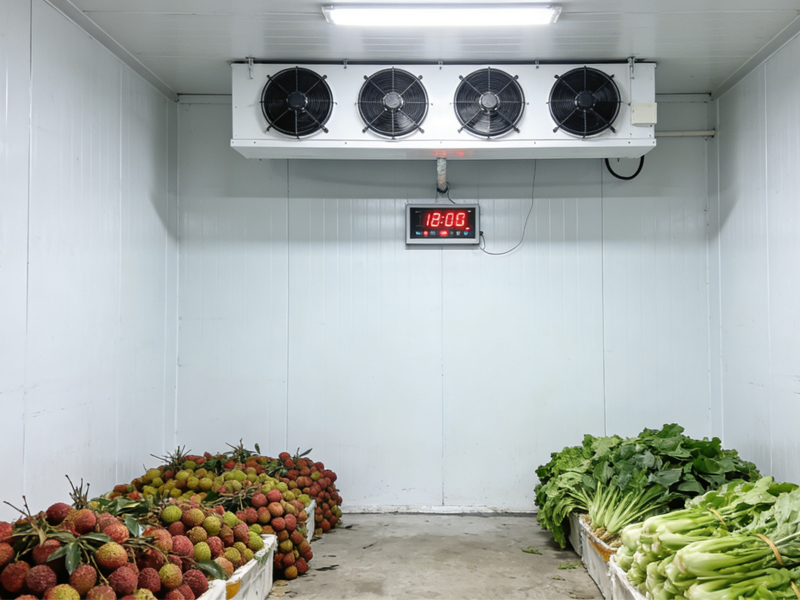
In the journey of fruits and vegetables from the fields to the dining table, the "first level" often determines the final quality. Many high-quality agricultural products are lost during transportation, not due to long distances, but because they were not cooled down in a timely manner after harvesting. Pre cold storage in the production area is the key facility to solve this pain point - it can quickly lock in freshness and nutrition during the most fragile moments of fruits and vegetables.
Scale calculation: Design capacity based on daily harvest volume, variety characteristics (such as strawberries requiring rapid pre cooling, potatoes can be slowly cooled), and market throughput. Small and medium-sized farms can consider modular mobile cold storage for flexible adjustment.
Vacuum pre cooling: efficient and fast (20-30 minutes cooling), suitable for large surface area categories such as leafy vegetables and mushrooms, but with high equipment investment.
Cold water pre cooling: soaking or spraying with ice water, suitable for broccoli, corn, etc., attention should be paid to water quality management and drying steps.
Differential pressure pre cooling: Combining the advantages of air cooling and vacuum, energy-saving and uniform, it is becoming the mainstream choice in emerging production areas.
Thermal insulation material: The warehouse body adopts polyurethane sandwich panels (thickness ≥ 10cm), and the moisture-proof layer on the ground cannot be ignored.
Renewable energy integration: Regions with abundant sunshine can be equipped with photovoltaic power supply to reduce long-term operating costs.
Traceability system: Record the pre cooling time and temperature curve of each batch of fruits and vegetables, and scan the code to obtain the entire data.
Green transformation: Technologies such as ammonia refrigerant substitution and waste heat recovery are being promoted to meet the carbon footprint requirements of markets such as the European Union.
Integration of "pre cooling+graded packaging": In the future, the production hub will integrate pre cooling, sorting, and packaging processes, directly connect with e-commerce platforms, and shorten the supply chain.
Why has pre cold storage become a standard feature in production areas?
After picking fruits and vegetables, they will continue to release heat and water. If not cooled down quickly, it can easily lead to wilting and decay. According to statistics, in traditional transportation, the loss rate of uncooled fruits and vegetables can reach 20% -40%, while pre cooling can reduce this number to below 5%. For high value-added fruits and vegetables (such as berries, leafy vegetables, and high-end fruits), pre cooling is an essential step in export and remote transportation.The four core steps for building a pre cold storage facility
1. Site selection and scale planning
Close to the place of origin: The pre cold storage should be built within 5 kilometers of the picking area to ensure storage within 30 minutes.Scale calculation: Design capacity based on daily harvest volume, variety characteristics (such as strawberries requiring rapid pre cooling, potatoes can be slowly cooled), and market throughput. Small and medium-sized farms can consider modular mobile cold storage for flexible adjustment.
2. Technical selection: Four mainstream pre cooling methods
Forced ventilation pre cooling: Low cost, cooling through cold air circulation, suitable for pressure resistant fruits and vegetables such as carrots and onions.Vacuum pre cooling: efficient and fast (20-30 minutes cooling), suitable for large surface area categories such as leafy vegetables and mushrooms, but with high equipment investment.
Cold water pre cooling: soaking or spraying with ice water, suitable for broccoli, corn, etc., attention should be paid to water quality management and drying steps.
Differential pressure pre cooling: Combining the advantages of air cooling and vacuum, energy-saving and uniform, it is becoming the mainstream choice in emerging production areas.
3. Equipment and energy configuration
Refrigeration unit: It needs to be matched with the heat load of fruits and vegetables. It is recommended to use a variable frequency energy-saving model and be equipped with a backup power supply.Thermal insulation material: The warehouse body adopts polyurethane sandwich panels (thickness ≥ 10cm), and the moisture-proof layer on the ground cannot be ignored.
Renewable energy integration: Regions with abundant sunshine can be equipped with photovoltaic power supply to reduce long-term operating costs.
4. Intelligent management system
Temperature and humidity monitoring: The sensor network tracks the parameters in the warehouse in real time and automatically adjusts the temperature through linkage.Traceability system: Record the pre cooling time and temperature curve of each batch of fruits and vegetables, and scan the code to obtain the entire data.
Challenges and Trends
Initial investment: Small and medium-sized farmers can reduce costs through cooperative construction, government subsidies, or leasing models.Green transformation: Technologies such as ammonia refrigerant substitution and waste heat recovery are being promoted to meet the carbon footprint requirements of markets such as the European Union.
Integration of "pre cooling+graded packaging": In the future, the production hub will integrate pre cooling, sorting, and packaging processes, directly connect with e-commerce platforms, and shorten the supply chain.